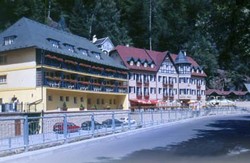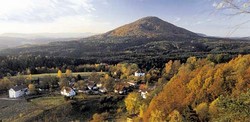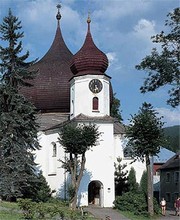
Železná Ruda
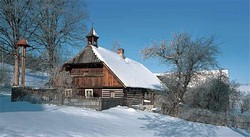
History of this mountain town is to a certain degree characteristic for dozens of similar villages and small towns all around the Šumava Mountains…
The colonization of Šumava somehow resembled to rotation of high and low tides. Settlements were approaching to the land border and then disappearing again. In the 13th century, when the colonization was at its peak, houses were built even at an altitude of 800 metres, then they moved to lower altitudes and a continuous settlement remained only in places with developed mining activities…
Landscape and architecture Číst více »
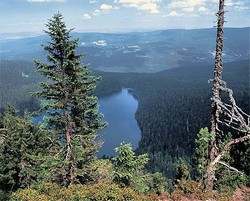
The Šumava lakes are almost places of pilgrimage, where people come with respect and reverence. It might be due to the unusual solemn atmosphere of deep forests and neighbouring rocks, or by the silent loneliness of these lakes, so intensively perceived by the Czech poet Jan Neruda who dedicated even a romance to the Black Lake…
When wandering through deep Šumava forests we may run across ancient paths resembling sometimes to an old sunken road overgrown with fern, other times to a dry stony trough meandering on a steep slope. Somewhere they are even covered by asphalt of a modern road. But the most often they have disappeared in the mountain landscape practically without any traces…
Across border forests Číst více »
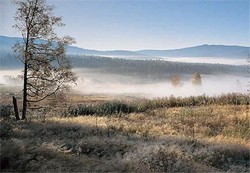
Probably no other Czech landscape has so many admirers as Šumava has. The reason might be that is has maintained its secrets, a certain inaccessibility, its legendary melancholy, swaying moors, milky fog in valleys, lonely wild rocks and impenetrable border forests…
Eternal inspiration Číst více »
Resembling to the biblical arch, the green Šumava is floating on the territory of three states as the largest forested area in Central Europe. It has been refuge of both Czechs and Germans, of bears, wolves and deer, of mountain cocks and eagles, spruces, firs, gentians, soldanellas and thousands of other more or less known creatures of God to which it has become home and to many of them even the last refuge from the turmoil of civilization. Two connected national parks on both Šumava´s slopes, on the Czech side enlarged by the belt of the protected landscape area, form one of the largest protected areas within the densely populated Europe…
In the densely populated Europe natural landscapes are becoming more and more rare and thus attractive…
Treasure of nature Číst více »
You can come to Volary by train either from České Budějovice or from Číčenice or Strakonice. But only a short segment Černý Kříž-Nové Údolí remained from the fourth railway from Waldkirchen and Haidmühle in Bavaria. We will now follow the 71 km long way from Strakonice passing through the highest situated railway station in the Czech Republic – Kubova Huť at an altitude of 995 m…
Going to Volary via Vimperk and Kubova Huť Číst více »
A quite unusual nature trail has been opened by the Šumava National Park and Protected Landscape Area Administration for particularly sensitive visitors of Šumava. It seems to be a contribution to the nationwide discussion on “What to do with Šumava forests destroyed by bark beetle?”
Transformation of a mountain spruce forest Číst více »
The history of Šumava canals for floating timber is at the same time the history of a small poor boy born in 1735 in the Schwarzenberg´s Šumava domain quite without any prospects, because he was an illegitimate child. In spite of that, as if good fairies were present that day in a small house in Chvalšiny to give the child really royal gifts: talent, tenacity and courage…
Rosenauer´s timber-floating canals Číst více »
When wandering across Šumava, we will be much impressed especially by the most beautiful of local rivers – Vydra with its rapids. This mountain torrent rises in the Modrava hollow at an altitude of 977 m where its three spring brooks meet – Modravský, Roklanský and Filipohuťský. They bring there brownish water from large peat bogs situated on the Šumava summits near the state border with Germany…
A romantic way along the Vydra River Číst více »
Although by its altitude Šumava is far from being a high mountain chain, it nevertheless succeeds to offer favourable conditions to some Alpine plants. Migration of Alpine cryophilic flora stared during the ice ages…
Immigrants from the Alps Číst více »
Although dozens of different ways, paths and trails lead across the Šumava Mountains, the Šumava nature trail is the most beautiful one of them. It was open to public in 1967 and is 14 km long. But even at that time it was not entirely new as it partly used old hunting footpaths beaten by hunters during centuries…
A vast blue water surface amidst the forested Šumava slopes – that is Lipno, the water of which has brought, some fifty years ago, a quite new life into the quiet Vltavická brázda Furrow. Under its water have disappeared many peat bogs, wet meadows, the very Vltava bed and even some villages and ways. In 1960, the reservoir above the dam was progressively filling with Vltava water and the new lake became the largest water surface in the former Czechoslovakia…
Sea in South Bohemia Číst více »
Šumava plains are one large source region. No wonder that also the longest and oldest Šumava river – Vltava – rises exactly here. Already in the Lower Tertiary, it used to flow soutwards through its Vltavická brázda Furrow…
The Šumava part of the Vltava River Číst více »
Although it is partly in ruins and overgrown with wood, it still dominates the whole environs from its rock pedestal. The Kašperk Castle has been the dominant of the northern Šumava region for nearly 650 years and all that times it has been bearing the proud name of its founder, king and emperor Charles IV…
The greatest riches of Šumava are its forests the species composition of which has stabilized roughly three thousands years ago. Such original forest would have grown in Šumava up to now if men had not come here…
Über Marienbad, auf weiten Bergplateaus des Slavkovsker Waldes, finden wir eine ausserordentlich schöne Landschaft mit nassen Wiesen und Mooren, Seen und Teichen…
Die Torfmoore von Kladská Číst více »
Es gibt Städte, die über Jahrhunderte mit bestimmten Attributen versehen waren. Kynžvart bekam zwar 1862 seinen offiziellen Namen: Kurort Kynžvart, war jedoch bereits seit der Zeit nach der Schlacht bei Bílá hora( Am weissen Berg) mit der rheinischen Adelsfamilie Metternich verbunden…
Kynžvart und Metternich Číst více »
Der Fluss Ohře, der sich seinen Weg durch den unteren Erzgebirgsriss bahnt, hält in seiner Schlinge einen abgelegenen Felsenvorsprung gefangen und würgt ihn immer stärker ab. Heute verbindet die Halbinsel mit seinem väterlichen Slavkover Wald nur eine sehr schmale Landenge…
Die königliche Stadt Loket Číst více »